Going through the Bible a chapter a day

https://www.biblegateway.com/passage/?search=Leviticus%2011&version=KJV

Leviticus 5: Trespass Offerings: specific sins such as ignoring a call to testify, touching something or someone ceremonially unclean, or speaking without thinking. 

Leviticus 6: Trespass Offering and Restitution: for a breach of God’s commandments even if unintentional (disobedience to God’s laws) there is a law offering relate to holiness for the tabernacle is holy.

Leviticus 7: Chapter 6:8-7:38 addresses Aaron and his sons the priesthood. The priests were the keepers and protectors of the law. The focus was to keep it holy not something to be taken lightly. 7:20 and 25 for an Israelite to be cut off from his people was the ultimate punishment.  To be cut off was to be taken outside of camp put to death or possibly banished forever.

Leviticus 8: God announces Aaron’s ordination through Moses. Aaron was made high priest and his sons priests because God had chosen them.
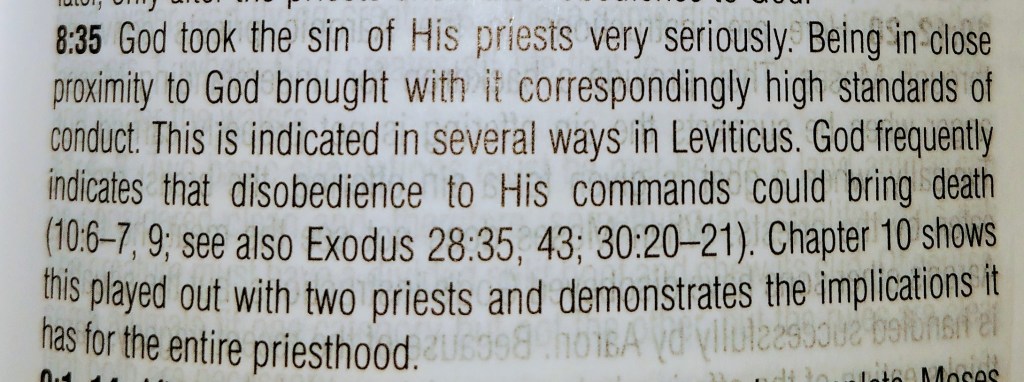
Verse 35 was mentioned below in my Bible and thought you would enjoy reading it.

Leviticus 9: The Priests Begin Their Ministry: After the ordination of Aaron and his sons is completed Moses calls them and the leaders of Israel. He tells Aaron to make a sin offering and burnt offering for his own atonement, and then tells him to educate the Israelites about their responsibilities. To obey and draw near to God. Aaron and his priests sons perform their first ritual duties.

Leviticus 10: The Strange Fire of NaDab and Abihu: The sons of Aaron offered strange fire unto God and were not commanded to do so. This was in disobedience to God’s commands. The Lord sent out a fire to consume them and they were put to death. Moses used their death as a warning unto Aaron and his family and more rules were given unto them.

Leviticus 11: A Holy People: Their Food: clean/unclean food regulations.

Thanks for joining me in a week’s recap. I will try and send chapters first thing every morning this week. Please bare with me as I will be work 15 hour days this week including the weekend to come. I will do my best to get it out to you.

God bless you and your loved ones.

The Passion Easter Devotional

Day 3 of 7:

“Judas Betrays Jesus” Devotional – The Passion

When we read the story leading up to Jesus’ death, we never imagine ourselves as Judas. We’d much rather think of ourselves as John—the beloved disciple who stuck closest to Jesus. Yet, if we’re honest, there have been times when we’ve betrayed Jesus in our own lives for far less than 30 pieces of silver. 

Before The Last Supper, Judas had already been to the chief priests to do a little negotiating. They gave him an advance, and a desperate Judas went on his way. Now, all he had to do was wait for the right moment.

It came as Jesus was descending the Mount of Olives where He had fervently prayed for God to take this cup of suffering from Him. When He came down from the mountain, He saw Judas approaching. God certainly didn’t waste any time. 

“While he was still speaking a crowd came up, and the man who was called Judas, one of the Twelve, was leading them. He approached Jesus to kiss him, but Jesus asked him, ‘Judas, are you betraying the Son of Man with a kiss?’” (Luke 22:47-48, NIV)

Once he kissed Him, the men who had come to arrest Jesus stepped forward. The Bible says that one of the disciples (who remains nameless) grabbed a sword and cut off the ear of the servant of the high priest. 

Jesus told him to put his sword away, and He reached over and healed the man’s ear. The decision had already been made in Gethsemane. He had fully surrendered to God’s plan.

In Matthew 26:53-54, Jesus asks, “Do you think I cannot call on my Father, and he will at once put at my disposal more than twelve legions of angels? But how then would the Scriptures be fulfilled that say it must happen this way?”

You see, God used even Judas’ betrayal to carry out His ultimate plan. Verse 56 goes on to say that “all the disciples deserted him and fled.” With one kiss, Jesus was sentenced to death, and all of His friends abandoned Him.

There are times in life when trusted friends will betray you. But sometimes in order to move forward, you have to leave some people behind. Sometimes God’s will requires our sole attention. There are some purposes that can only be fulfilled on our own. Jesus knew what He had to do.

Luke 22:47-48 King James Version

47 And while he yet spake, behold a multitude, and he that was called Judas, one of the twelve, went before them, and drew near unto Jesus to kiss him.

48 But Jesus said unto him, Judas, betrayest thou the Son of man with a kiss?

Matthew 26:53-54 King James Version

53 Thinkest thou that I cannot now pray to my Father, and he shall presently give me more than twelve legions of angels?

54 But how then shall the scriptures be fulfilled, that thus it must be?

Awaken by Priscilla Shirer

Day 3 of 3:

— Day 85 —

Even That Thing

Be anxious for nothing, but in everything by prayer and supplication with thanksgiving let your requests be made known to God. Philippians 4:6

God’s activity is not confined to the spectacular and jaw-dropping. He does a plethora of things that never make headlines or invite peals of applause. Some of His work—dare I say, some of His best work—is performed on the most ordinary days, in the most ordinary places and ways, with ordinary people. Like us.

The tendency of humanity is to put God into our self-established theological box into which we hope He will comfortably fit, a box that doesn’t allow for the supernatural and amazing . . . because that is too big. But sometimes the box we’ve chosen doesn’t make room for Him to work in the routine and ordinary. That is too small.

Yet a God-box is still a God-box, no matter where you position it in your faith. Limiting our view of Him to the stupendous is not really any different from limiting our view of Him to the monotonous. He doesn’t exist only in the stratosphere of extravagant need. His ability comes all the way down to the ground, to the places we live on regular weekdays while working, playing, eating, and engaging in ordinary realities.

By no means does this understanding minimize Him to a trivial fraction of who He is. It actually magnifies the detailed and caring nature of His character. The same God who divided the Red Sea is the same God who knows about the loss of a solitary, fallen sparrow and takes the time to number the hairs on our heads (Matt. 10:29–30). He knows when His children are in grave agony, just as He knows and cares when it has simply been one of those really long mornings. Nothing escapes His attention. Nothing is too small to avoid His notice. He cares about it all.

In highlighting His attention to routine detail, the Scripture counteracts a lie we find so easy to believe—that God may have been loving enough to send His Son to die for us, taking care of our biggest thing, but He’s not much interested in taking care of our little things, our daily things, our too-small-tomention things. Yet “He who did not spare His own Son, but delivered Him over for us all, how will He not also with Him freely give us all things?” (Rom. 8:32).

There’s a comprehensiveness to God’s ability that covers all that concerns us. “He forgives all your iniquity; he heals all your diseases” (Ps. 103:3 csb). He invites “all who are weary and heavy-laden” to come experience His rest (Matt. 11:28). He says His lovingkindness “will follow me all the days of my life” (Ps. 23:6), and that if we seek His kingdom above every other desire, “all these things” will be given (Matt. 6:33)—full provision, food and clothing, love and shelter, every need.

He who is saving you from hell is also willing and able to save what’s left of your nerves and your workweek. Because even in the fine print of Scripture, we can trace the detailed care and concern of our God for everything we face.

Even that thing.

The mundane thing.

The ordinary thing.

The small thing.

Philippians 4:6 King James Version

Be careful for nothing; but in every thing by prayer and supplication with thanksgiving let your requests be made known unto God.

Side note

I worked 12 days straight with this being my break and I return to 12 days straight but doing double shifts as well. So, please bare with me if I miss some days. I will try and share first thing in the morning. I will be working 15 hour days coming this week will fo my best to have it ready for you.

Thanks for your understanding at this time. God bless you and your loved ones.

Awaken by Priscilla Shirer

Day 2 of 3: don’t forget the day listed below is from her book and this is only 3 day devotional.

— Day 34 —

Never Too Far Gone

When he was in distress, he entreated the Lord his God and humbled himself greatly before the God of his fathers. 2 Chronicles 33:12

To say Manasseh was an evil king is like saying the Grand Canyon is a hole in the ground. The Bible says he “shed so much innocent blood that he filled Jerusalem with it from one end to another” (2 Kings 21:16 csb). If any one monarch’s abominations were to blame for God’s abandonment of Judah to exile, it was this king who had “done wickedly more than all the Amorites did who were before him” (2 Chron. 33:11).

Gratefully, God is not a stoic being who deals with humankind in a manner devoid of emotions and sentiments. “The Lord is compassionate and gracious, slow to anger and abounding in lovingkindness. He will not always strive with us, nor will He keep His anger forever. He has not dealt with us according to our sins, nor rewarded us according to our iniquities. For as high as the heavens are above the earth, so great is His lovingkindness toward those who fear Him” (Ps. 103:8–11).

Even when we’ve chosen unwisely, even when we’ve relished our stubborn resistance, He remains eager to express these beautiful elements of His character to us. He longs to receive the rebellious back into His welcoming arms. He loves seeing His grace exalted and watching it change us into His image. Nothing we’ve done, no matter how devastating or devious, can push us too far out of His love to reach us, rescue us, and restore us. When we call to Him, He hears us.

Just like He heard Manasseh . . .

For when the Lord sent the armies of a foreign nation against him, “and they captured Manasseh with hooks, bound him with bronze chains and took him to Babylon” (2 Chron. 33:11), judgment fell like hailstones. But in his distress, Manasseh “humbled himself greatly” (v. 12) before the Lord. And God “was moved by his entreaty and heard his supplication, and brought him again to Jerusalem to his kingdom” (v. 13). After such bountiful restoration, Manasseh received his kingdom back, and the remainder of his life (vv. 14–16) looked a whole lot different than the first.

When we respond to our Father’s discipline by humbling ourselves with the “godly sorrow” of true repentance (2 Cor. 7:11), He will pour out His mercy on us. It’s never too late, and you are never too far gone, to receive the restoring power of the One who loves you.

2 Chronicles 33:12 King James Version

12 And when he was in affliction, he besought the Lord his God, and humbled himself greatly before the God of his fathers,

The Passion Easter Devotional

Day 2 of 7

“The Garden of Gethsemane” Devotional –  The Passion

The Garden of Gethsemane gives us one of the greatest glimpses into the true humanity of Jesus. Though He was without sin, He was fully God and fully man. On the Mount of Olives, as He knelt down to pray, the King of Kings was deeply troubled.

In Matthew 26:38, the Bible says He told the disciples, “My soul is overwhelmed with sorrow to the point of death. Stay here and keep watch with me.” (NIV)

And then Jesus did the only thing He knew to do. He turned to the Father.

Matthew continues: “Going a little farther, he fell with his face to the ground and prayed, ‘My Father, if it is possible, may this cup be taken from me. Yet not as I will, but as you will.’” (v. 39)

The Bible says He prayed this same prayer three times, pleading with God to change His mind. Isn’t there another way, Father? Must I die to save these people? Jesus already knew the answer, but now that it was getting real, He had to come to terms with it. He had to accept that there was a greater plan in play. He needed to know that what He was about to do would serve a larger purpose. He needed to know it would matter. 

Have you had a Gethsemane moment? Perhaps God has asked you to do something hard, something that requires great sacrifice. And, quite frankly, you don’t want to endure the pain it requires. Every believer has felt the tension of following Christ. After all, He asks us to lay down our lives and pick up His cross. And that, friends, can be painful. 

Sometimes it looks like losing a friend or making an unpopular choice. Other times, it looks like leaving everything familiar behind and stepping outside our comfort zones. Often, it looks like forgiving someone who doesn’t deserve forgiveness. But every time, it leads us back to Jesus. Every time He asks us to sacrifice something, He always draws us back to Himself, proving time and time again that He is Comforter, Provider, Friend and Prince of Peace.

We know how this story ends, don’t we? God didn’t take the cup from Him. Jesus died on that cross, murdered for sins He didn’t commit, all in obedience to the Father. Sometimes obedience is the purpose. His will, not ours.

Matthew 26:38 King James Version

38 Then saith he unto them, My soul is exceeding sorrowful, even unto death: tarry ye here, and watch with me.

Matthew 26:39 King James Version

39 And he went a little farther, and fell on his face, and prayed, saying, O my Father, if it be possible, let this cup pass from me: nevertheless not as I will, but as thou wilt.