The Passion Easter Devotional

Day 5 of 7:

“The Thief” Devotional – The Passion

“Two other men, both criminals, were also led out with him to be executed. When they came to the place called the Skull, they crucified him there, along with the criminals—one on his right, the other on his left. Jesus said, ‘Father, forgive them, for they do not know what they are doing.’ And they divided up his clothes by casting lots.” (Luke 23:32-34, NIV)

Jesus wasn’t the only one put to death that day. Two other men were crucified as well. The New International Version in Matthew calls them “rebels.” The two who flanked Jesus on either side were, indeed, criminals. Guilty, they both stood in stark contrast to a blameless Jesus. Yet, their individual responses to Jesus were completely different.

Verse 39 in Luke 23 says, “One of the criminals who hung there hurled insults at him: ‘Aren’t you the Messiah? Save yourself and us!’” This scene recalls the time when Satan was tempting Jesus, taunting Him, asking Him to do things on the enemy’s terms. In that instance and in this one, we quickly learn that God will not be mocked. The naysayers don’t get the final word.

The second man hanging beside Him takes a different approach. The story continues in Luke 23: “But the other criminal rebuked him. ‘Don’t you fear God,’ he said, ‘since you are under the same sentence? We are punished justly, for we are getting what our deeds deserve. But this man has done nothing wrong.’ Then he said, ‘Jesus, remember me when you come into your kingdom.’” (v. 40-42)

The second man recognized Jesus for who He was—the perfect, sinless Savior of the world. He also recognized himself for who he was in that moment—a sinful human. Though Scripture never specifies what he had been found guilty of, the man owned it. He admitted his sin, and he asked Jesus to forgive him. 

“Jesus answered him, ‘Truly I tell you, today you will be with me in paradise.’” (Luke 23:43)

So, who are you in this story? Are you the man who mocks Jesus, daring to ask Him to prove His power and authority? Or are you the other man? The man who owns up to his wrongs and asks Jesus for forgiveness.

Truth be told, there’s a little bit of each of these men in all of us, isn’t there?

Luke 23:32-34 King James Version

32 And there were also two other, malefactors, led with him to be put to death.

33 And when they were come to the place, which is called Calvary, there they crucified him, and the malefactors, one on the right hand, and the other on the left.

34 Then said Jesus, Father, forgive them; for they know not what they do. And they parted his raiment, and cast lots.

Luke 23:39 King James Version

39 And one of the malefactors which were hanged railed on him, saying, If thou be Christ, save thyself and us.

Luke 23:40-43King James Version

40 But the other answering rebuked him, saying, Dost not thou fear God, seeing thou art in the same condemnation?

41 And we indeed justly; for we receive the due reward of our deeds: but this man hath done nothing amiss.

42 And he said unto Jesus, Lord, remember me when thou comest into thy kingdom.

43 And Jesus said unto him, Verily I say unto thee, Today shalt thou be with me in paradise.
Who’s in Charge of a World That Suffers? By Billy Graham

Day 2 of 5:

He is a God of Love

God is not blind to man’s plight. He does not stand on a mountaintop, helplessly viewing the crash of mankind. Since man caused his own crash by his rebellion against the Creator, God could have allowed him to plunge on in darkness and destruction. This would have been in keeping with God’s holiness and righteousness. However, this other great attribute of God, His love, would not allow Him to do it. From the very beginning of that crash, God had a plan for man’s deliverance, redemption and reconciliation. In fact the plan is so fantastic that it ultimately lifts man far beyond and above even the angels. God’s all-consuming love for mankind was decisively demonstrated at the cross, where His compassion was embodied in His Son Jesus Christ. The word compassion comes from two Latin words meaning “to suffer with.” God was willing to suffer with man. 

In the thirty-three years preceding His death, Jesus suffered with man; and ultimately He suffered for man on the cross. “God was reconciling the world to himself in Christ” (2 Cor. 5:19). Again, “God demonstrates his own love for us in this: While we were still sinners, Christ died for us” (Rom. 5:8). 

It was the love of God that sent Jesus Christ to the cross. It was because He was in control and controlled by love that He provided that divine substitute for our sin. 

God’s love did not begin at the cross. It began before the world was established, before the time clock of civilization began to move. The concept stretches our understanding to the utmost limits of our minds. Turn back in your imaginations to the countless eons before God created this present earth, when it was “without form and void” and the deep, silent darkness of outer space formed a vast gulf between the brilliance of God’s throne and the dark vacuum where our present solar system now exists. Imagine the brilliance of God’s glory as the cherubim and seraphim, the very angels themselves, cover their faces with their wings in awe and reverence toward Him who is the high and holy One who inhabits eternity! 

Even at this time He foreknew all that would happen, and yet, in His mysterious love, He allowed it. The Bible tells us about the “Lamb that was slain from the creation of the world” (Rev. 13:8). God foresaw what His Son was to suffer. As it has been said, there was a cross in the heart of God long before the cross was erected at Calvary. Only as we think in these terms will we begin to grasp the wonder and greatness of His love for us.

Respond

How does the knowledge that God is compassionate towards our suffering change your perspective on your circumstances?

How does Scripture provide evidence for the depth of God’s love for us? 

Read Romans 8:38-39. How can you apply this message of hope to a suffering world?

2 Corinthians 5:19 King James Version

19 To wit, that God was in Christ, reconciling the world unto himself, not imputing their trespasses unto them; and hath committed unto us the word of reconciliation.

Romans 5:8 King James Version

But God commendeth his love toward us, in that, while we were yet sinners, Christ died for us.

The Passion Easter Devotional

Day 4 of 7:

“Peter Denies Jesus” Devotional – The Passion

“The Lord turned and looked straight at Peter. Then Peter remembered the word the Lord had spoken to him: ‘Before the rooster crows today, you will disown me three times.’ And he went outside and wept bitterly.” (Luke 22:61-62, NIV)

At The Last Supper, Peter had declared that he would never deny Jesus, that he would never leave His side. Never say never, Peter. Jesus already knew in that moment that  he would deny him not once, not twice, but three times.

“Never!” Peter said.

After Jesus had been arrested, Peter looked on from a distance as they led him away. A portion of the crowd had gathered in the courtyard, and Peter sat down by the fire. There, a servant girl recognized his earlier proximity to Jesus. But Peter told her, “Woman, I don’t know him.” (v. 57)

Later on, someone accused him of being one of The Twelve, and Peter replied, “Man, I am not!” (v. 58)

Finally, an hour later, a third person confirmed that he had been spotted with Jesus. Verse 60 seals the deal: “Peter replied, ‘Man, I don’t know what you’re talking about!’ Just as he was speaking, the rooster crowed.”

Haven’t we all been like Peter? We defend ourselves—perhaps with a little bit of pride—and say we would never disown Jesus. Yet, in the next instant when following Jesus becomes too inconvenient, too risky, too uncomfortable or too unpopular, we’re content to pretend like we’re not on His team…or we sit back and say nothing at all. After all, what would people think if we took a stand? What would they say if we aligned ourselves with Jesus?

We often deny Jesus on a regular basis out of fear and pride. And it appears Peter was operating under a bit of trembling and arrogance that day. Let’s just say it wasn’t his finest moment. 

We can identify, can’t we? It’s far easier to just go with the flow than to swim upstream with Jesus. It’s far more acceptable to live in the grey than to stick to black and white beliefs. But that’s not the life Jesus calls us to. He wants our unwavering allegiance at all times. 

The best part of this story actually happens after the resurrection. Jesus comes back from the dead, and the first person He’s looking for is Peter. Can you imagine how terrified Peter must have been? Or maybe it wasn’t terror he was feeling at all. Maybe it was relief—relief that he could finally tell Jesus he was sorry; that he hadn’t meant what he said. When Jesus finds him, He gives him a second chance. Because even when we deny Him, He always gives us chance after chance to follow Him again.

Luke 22:61-62 King James Version

61 And the Lord turned, and looked upon Peter. And Peter remembered the word of the Lord, how he had said unto him, Before the cock crow, thou shalt deny me thrice.

62 And Peter went out, and wept bitterly.

Luke 22:57 King James Version

57 And he denied him, saying, Woman, I know him not.

Luke 22:58 King James Version

58 And after a little while another saw him, and said, Thou art also of them. And Peter said, Man, I am not.

Who’s in Charge of a World that Suffers? By Billy Graham

Day 1of 5:

The Reality of Suffering

Suffering is difficult to talk or write about, for it is not something that can adequately be examined outside the realm of experience. It is not abstract, nor is it philosophical. It is real and concrete. It leaves its scars. When the winds of adversity have passed, we are seldom unchanged. It is only when one has passed through a crisis event that one can truly comprehend what it means to suffer. And often it is only in retrospect that we realize the purpose and value of our suffering. 

Struggles in life can uncover untold depths of character and unknown strength for service. People who go through life unscathed by sorrow and untouched by pain tend to be shallow in their perspective on life. Suffering, on the other hand, tends to plow up the surface of our lives to uncover the depths that provide greater strength of purpose and accomplishment. Only deeply plowed earth can yield bountiful harvests. 

Pain has many faces. One can suffer physically, mentally, emotionally, psychologically, and spiritually. Our difficulties are rarely confined to only one of these areas; they tend to overlap in human experiences. Some of the most intensive suffering can be psychologically induced and frequently lead to complications in the physical realm. 

There are as many invisible hurts as there are visible hurts, and there can be difficulty in diagnosing them. We know that the unseen part of man is often the victim of the most debilitating of pains. In certain circumstances, a man can endure excruciating physical pain; and yet he can be felled by one unkind word. When we hear the story of the torture inflicted upon a P.O.W., we are astounded by his personal fortitude and the resiliency of the human body. But that same man’s life can be devastated by a single viciously perpetrated act or word. 

Scripture has much to say about the power of the tongue to inflict cruelty. The psalmist says that bitter words are like deadly arrows. James wrote: “The tongue is a small part of the body, but it makes great boasts. Consider what a great forest is set on fire by a small spark. The tongue also is a fire, a world of evil among the parts of the body” (James 3:5, 6). 

Man is capable of great victories and susceptible to great defeats. Man is both strong and sensitive. As the psalmist exclaimed, “I praise you because I am fearfully and wonderfully made” (Ps. 139:14). 

In earnest we must endeavor to apply this sensitivity when dealing with the matter of suffering, especially as we consider the sufferings of others. We cannot feel someone else’s pain. We can see the anguish in his face and try to empathize. But we do not have his nerve endings. We cannot fully know the magnitude of his anguish. We must never minimize the suffering of another. Scripture’s mandate to us is, ‘‘Weep with them that weep” (Rom. 12:15, kjv).

Our physical sufferings express a great truth. As C. S. Lewis cogently penned, “Pain . . . plants the flag of truth within the fortress of a rebel soul.”1 The truth is this—man’s body is mortal, temporal. Man must look beyond himself to find immortality. 

Suffering is one of God’s ways of speaking to us, of awakening us to our need of Him, and calling us to Himself. To quote C. S. Lewis again: “God whispers to us in our pleasures, speaks in our conscience, but shouts in our pains: it is His megaphone to rouse a deaf world.”2 If our suffering leads us to God, it has become a blessed and precious friend. 

We are indebted to modern medical science for the tremendous strides made in finding cures for so many diseases and harnessing others. And yet pain is still with us. Many of you know the reality of cancer, strokes, heart attacks, birth defects, auto injuries. Many of you have been bedridden and racked with pain for years. Some of you are shocked by the discovery of a friend’s or relative’s terminal illness. Maybe you yourself are facing the prospect of death. Let me assure you that you do not need to face your situation alone. God wants to comfort and help you. 

Some suffering comes as a natural result of the deterioration of the body. Some forms of physical suffering are inflicted upon us by others. 

There may come a day when we Americans will undergo intense persecution for our faith. Are you prepared to face martyrdom? Jesus gave His life for you. You may be called to give your life for Him. God has many precious promises for those who suffer for Christ. 

Respond

What might a “bountiful harvest” as a result of suffering look like?

How have you seen God’s work manifest itself in your life during or following times of deep suffering? 

What is meant by “The tongue is also a fire, a world of evil among the parts of the body” (as described in James 3:5,6)? How does this impact the way you relate to others who are suffering?

How do the promises of God set forth in Scripture impact how you relate to God while walking through hard times?

Romans 12:15 King James Version

15 Rejoice with them that do rejoice, and weep with them that weep.

Psalm 139:14 King James Version

14 I will praise thee; for I am fearfully and wonderfully made: marvellous are thy works; and that my soul knoweth right well.

Going through the Bible a chapter a day

https://www.biblegateway.com/passage/?search=Leviticus%2011&version=KJV

Leviticus 5: Trespass Offerings: specific sins such as ignoring a call to testify, touching something or someone ceremonially unclean, or speaking without thinking. 

Leviticus 6: Trespass Offering and Restitution: for a breach of God’s commandments even if unintentional (disobedience to God’s laws) there is a law offering relate to holiness for the tabernacle is holy.

Leviticus 7: Chapter 6:8-7:38 addresses Aaron and his sons the priesthood. The priests were the keepers and protectors of the law. The focus was to keep it holy not something to be taken lightly. 7:20 and 25 for an Israelite to be cut off from his people was the ultimate punishment.  To be cut off was to be taken outside of camp put to death or possibly banished forever.

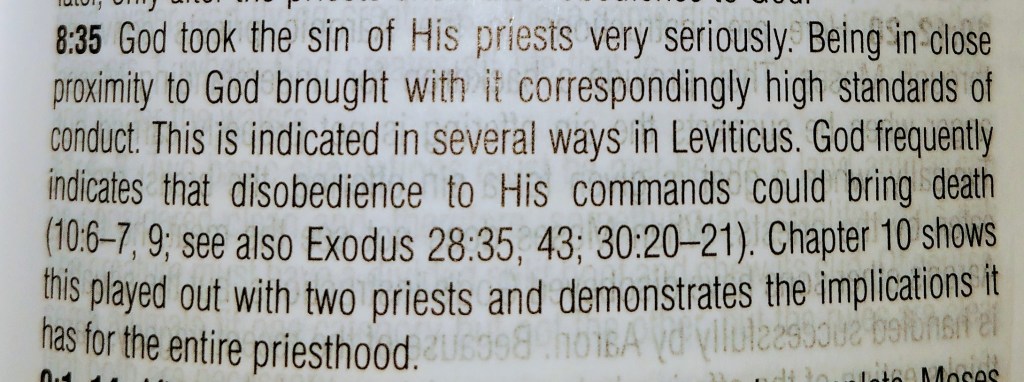
Leviticus 8: God announces Aaron’s ordination through Moses. Aaron was made high priest and his sons priests because God had chosen them.

Verse 35 was mentioned below in my Bible and thought you would enjoy reading it.

Leviticus 9: The Priests Begin Their Ministry: After the ordination of Aaron and his sons is completed Moses calls them and the leaders of Israel. He tells Aaron to make a sin offering and burnt offering for his own atonement, and then tells him to educate the Israelites about their responsibilities. To obey and draw near to God. Aaron and his priests sons perform their first ritual duties.

Leviticus 10: The Strange Fire of NaDab and Abihu: The sons of Aaron offered strange fire unto God and were not commanded to do so. This was in disobedience to God’s commands. The Lord sent out a fire to consume them and they were put to death. Moses used their death as a warning unto Aaron and his family and more rules were given unto them.

Leviticus 11: A Holy People: Their Food: clean/unclean food regulations.

Thanks for joining me in a week’s recap. I will try and send chapters first thing every morning this week. Please bare with me as I will be work 15 hour days this week including the weekend to come. I will do my best to get it out to you.

God bless you and your loved ones.

The Passion Easter Devotional

Day 3 of 7:

“Judas Betrays Jesus” Devotional – The Passion

When we read the story leading up to Jesus’ death, we never imagine ourselves as Judas. We’d much rather think of ourselves as John—the beloved disciple who stuck closest to Jesus. Yet, if we’re honest, there have been times when we’ve betrayed Jesus in our own lives for far less than 30 pieces of silver. 

Before The Last Supper, Judas had already been to the chief priests to do a little negotiating. They gave him an advance, and a desperate Judas went on his way. Now, all he had to do was wait for the right moment.

It came as Jesus was descending the Mount of Olives where He had fervently prayed for God to take this cup of suffering from Him. When He came down from the mountain, He saw Judas approaching. God certainly didn’t waste any time. 

“While he was still speaking a crowd came up, and the man who was called Judas, one of the Twelve, was leading them. He approached Jesus to kiss him, but Jesus asked him, ‘Judas, are you betraying the Son of Man with a kiss?’” (Luke 22:47-48, NIV)

Once he kissed Him, the men who had come to arrest Jesus stepped forward. The Bible says that one of the disciples (who remains nameless) grabbed a sword and cut off the ear of the servant of the high priest. 

Jesus told him to put his sword away, and He reached over and healed the man’s ear. The decision had already been made in Gethsemane. He had fully surrendered to God’s plan.

In Matthew 26:53-54, Jesus asks, “Do you think I cannot call on my Father, and he will at once put at my disposal more than twelve legions of angels? But how then would the Scriptures be fulfilled that say it must happen this way?”

You see, God used even Judas’ betrayal to carry out His ultimate plan. Verse 56 goes on to say that “all the disciples deserted him and fled.” With one kiss, Jesus was sentenced to death, and all of His friends abandoned Him.

There are times in life when trusted friends will betray you. But sometimes in order to move forward, you have to leave some people behind. Sometimes God’s will requires our sole attention. There are some purposes that can only be fulfilled on our own. Jesus knew what He had to do.

Luke 22:47-48 King James Version

47 And while he yet spake, behold a multitude, and he that was called Judas, one of the twelve, went before them, and drew near unto Jesus to kiss him.

48 But Jesus said unto him, Judas, betrayest thou the Son of man with a kiss?

Matthew 26:53-54 King James Version

53 Thinkest thou that I cannot now pray to my Father, and he shall presently give me more than twelve legions of angels?

54 But how then shall the scriptures be fulfilled, that thus it must be?